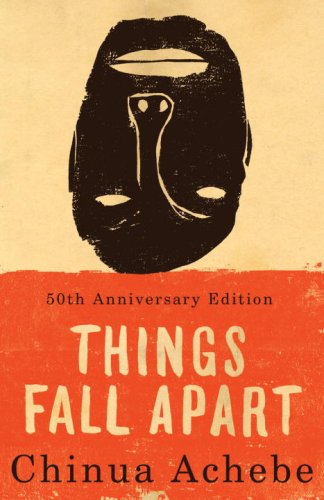
Things Fall Apart
by Chinua Achebe
First published in 1958
Paperback, 224 Pages
In young Okonkwo's young life, he loathed his father for his failures. Okonkwo, had to fend for his family from a very young age. With his valor and fear of failure, he became the youngest wrestler and was well-known in his clan, Umuofi. His fear of failure, made him lead his family, through tough work, he never showed any emotion of love. Even when he was given Ikemefuna.He deals with him the same way he deals with his other sons. He also deals with his sorrow for Ikemefuna in the same way and comes out of it. But despite all this, he unknowingly commits a mistake because of which he has to leave his clan for 7 years.
This is when, the story takes an interesting turn. This is when we see the change in th e Igbo culture. This is when we "watch" the Missionaries, Christainity slowly walking into there clan demanding a change in there centuries-old beliefs and traditions. They build churches, they bring in a new government and they totally wipe-out a whole clan spreading fear and anxiety among the other clans. Okonkwo doesn't take this change lightly. Chinua Achebe gracefully takes us through the troubled times in Nigeria, he opens a world, that had been unknown to a new modern world.
I feel that a novella cannot be successful, if you don't feel for the characters. And I really felt for Okonkwo. I really felt sad for him when he had to "deal" with Ikemefuna, his adopted son. I felt for his own son, Nwoye and for all the many characters.
This is one novella, I enjoyed and I hope you too!
Hubby dear bought this for me last year! And well I am GLAD, I finally picked it up!
by Chinua Achebe
First published in 1958
Paperback, 224 Pages
Lliterary awards
From GoodReads.com,
Everyone knows about Things Fall Apart, it is the book that is believed to have opened the mystical world of Africa to the mordern world.THINGS FALL APART tells two overlapping, intertwining stories, both of which center around Okonkwo, a “strong man” of an Ibo village in Nigeria. The first of these stories traces Okonkwo's fall from grace with the tribal world in which he lives, and in its classical purity of line and economical beauty it provides us with a powerful fable about the immemorial conflict between the individual and society. The second story, which is as modern as the first is ancient, and which elevates the book to a tragic plane, concerns the clash of cultures and the destruction of Okonkwo's world through the arrival of aggressive, proselytizing European missionaries. These twin dramas are perfectly harmonized, and they are modulated by an awareness capable of encompassing at once the life of nature, human history, and the mysterious compulsions of the soul. THINGS FALL APART is the most illuminating and permanent monument we have to the modern African experience as seen from within.
Turning and turning in the widening gyre The falcon cannot hear the falconer; Things Fall Apart ; the center cannot hold; Mere anarchy is loosed upon the world.
—W. B. Yeats, “The Second Coming”
This book is recognized as a literary classic and is taught and read everywhere in the English-speaking world. The novel has been translated into at least forty-five languages and has sold several million copies. A year after publication, the book won the Margaret Wong Memorial Prize, a major literary award.It has been a great experience reading this one. For the first part of the novel, I thought, it would be difficult to remember all the African words, but amazingly I got used to it. Almost everyone knows the story and the main protagonist Okonkwo.
- From CliffsNotes.com
In young Okonkwo's young life, he loathed his father for his failures. Okonkwo, had to fend for his family from a very young age. With his valor and fear of failure, he became the youngest wrestler and was well-known in his clan, Umuofi. His fear of failure, made him lead his family, through tough work, he never showed any emotion of love. Even when he was given Ikemefuna.He deals with him the same way he deals with his other sons. He also deals with his sorrow for Ikemefuna in the same way and comes out of it. But despite all this, he unknowingly commits a mistake because of which he has to leave his clan for 7 years.
This is when, the story takes an interesting turn. This is when we see the change in th e Igbo culture. This is when we "watch" the Missionaries, Christainity slowly walking into there clan demanding a change in there centuries-old beliefs and traditions. They build churches, they bring in a new government and they totally wipe-out a whole clan spreading fear and anxiety among the other clans. Okonkwo doesn't take this change lightly. Chinua Achebe gracefully takes us through the troubled times in Nigeria, he opens a world, that had been unknown to a new modern world.
I feel that a novella cannot be successful, if you don't feel for the characters. And I really felt for Okonkwo. I really felt sad for him when he had to "deal" with Ikemefuna, his adopted son. I felt for his own son, Nwoye and for all the many characters.
This is one novella, I enjoyed and I hope you too!
Hubby dear bought this for me last year! And well I am GLAD, I finally picked it up!

